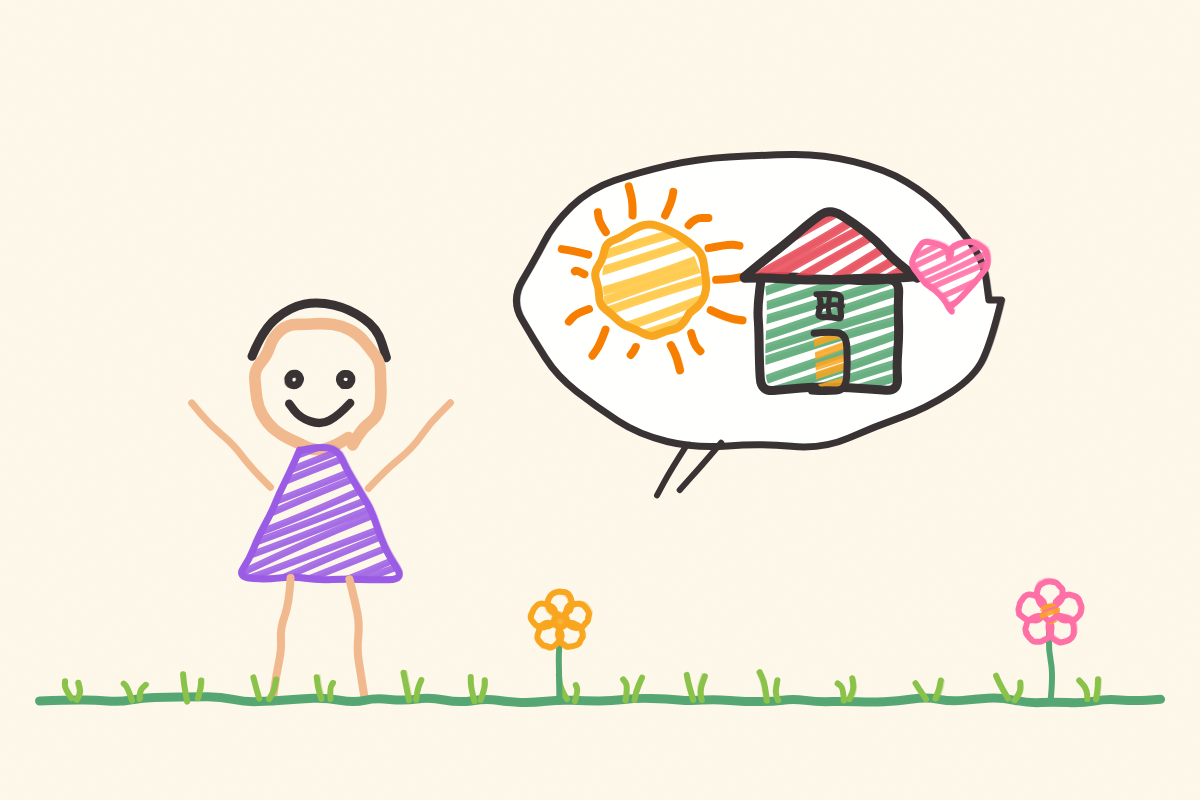
Every parent has experienced the longer version of this: you ask your child about a drawing, and they don't just tell you what it is — they tell you everything. The backstory of the character, the landscape of the world, the event that led to this particular moment being captured, the sequel that hasn't happened yet but definitely will, the minor characters in the background and their whole separate storylines.
You were hoping for thirty seconds of explanation. You got fifteen minutes of world-building. You missed your window to start dinner.
And yet. Something important just happened in that room.
Language Development in Action
When a child explains their artwork, they're doing something linguistically sophisticated. They're constructing a narrative in real time — selecting relevant information, sequencing it, adjusting their explanation based on cues from their audience, and making vocabulary choices about how to describe visual elements that language wasn't quite designed for.
This is, functionally, the same cognitive work involved in writing. It's the oral form of composition — and studies exploring early literacy development have consistently found that children's narrative skill in oral language is one of the strongest predictors of later reading comprehension.
Letting children explain their artwork isn't just pleasant. It's providing practice in one of the most important cognitive capacities they're building.
Emotional Articulation
Art has always functioned as a way of processing experience — for adults as much as for children. What's distinctive about a child narrating their drawing is that the narration makes the processing explicit and social.
When a child draws something difficult — a fight with a friend, a scary experience, a worry they're carrying — they may not yet have language for it in direct form. The drawing is the indirect route. And the explanation of the drawing is often where the feeling comes out — not as "I'm worried about X" but as "and then the character in the story was really scared and didn't know what to do."
Sensitive parents learn to listen for these transpositions. The drawing is not the worry, but the worry is in the drawing. The explanation isn't the feeling, but the feeling is in the explanation. Being the kind of parent who creates space for that narration — who asks and then actually listens — creates the conditions in which children feel safe to process hard things through the indirect route of creativity.
Critical Thinking and Aesthetic Choice
There's a less often discussed benefit of letting children explain their art: it develops their capacity to make and articulate conscious creative choices.
When you ask "How did you decide to use that colour?" or "Why is this character bigger than the others?", you're inviting the child to reflect on their own decision-making — to go from intuitive choice to articulated reasoning. This is a genuinely useful cognitive practice that extends well beyond art. It's the foundation of creative criticism, of the ability to say: I made this decision because I was going for this effect.
Most adults who are confident creative thinkers can trace part of that confidence to early experiences of having their choices taken seriously and asked about. The question "why did you decide..." implies that the decision was worth making deliberately — and over time, children begin to approach their creative work more deliberately as a result.
Social Skills and Perspective-Taking
There's also a relational dimension to artwork explanation that's easy to overlook. When a child explains their drawing to you, they're practising communication — managing the fact that you don't have access to the information in their head, building a bridge between their internal experience and yours.
This perspective-taking — understanding that you don't already know what they're thinking, and that they need to provide enough context for you to follow — is a key component of social cognition. Practice at building that bridge, in the low-stakes context of explaining a drawing, builds the general capacity.
The Simple Practice
None of this requires any expertise or any specific programme. It requires one thing: asking, and then genuinely listening.
The specific questions that elicit the richest explanations make a real difference. But even a simple "Tell me about this" — delivered with genuine attention and followed by actual listening — creates the space for most of these benefits to occur.
The explanation your child gives doesn't need to be captured or preserved every time, though capturing it occasionally creates something remarkable to return to. What matters is that the space for it exists, regularly, in the fabric of your days.
That's a low bar and a high return. Probably the best combination in all of parenting.
Every child is different. Trust your instincts — you know your child best.
A gentle note from us: we're parents and makers, not paediatricians. Every child is wonderfully their own, and they grow at their own pace. If something about your little one's development is weighing on your heart, please have a chat with your family doctor — that's exactly what they're there for, and asking is always the right call.
Ready to start keeping their stories?
My Mini Canvas is on iPhone and iPad now — free to start, no account needed.