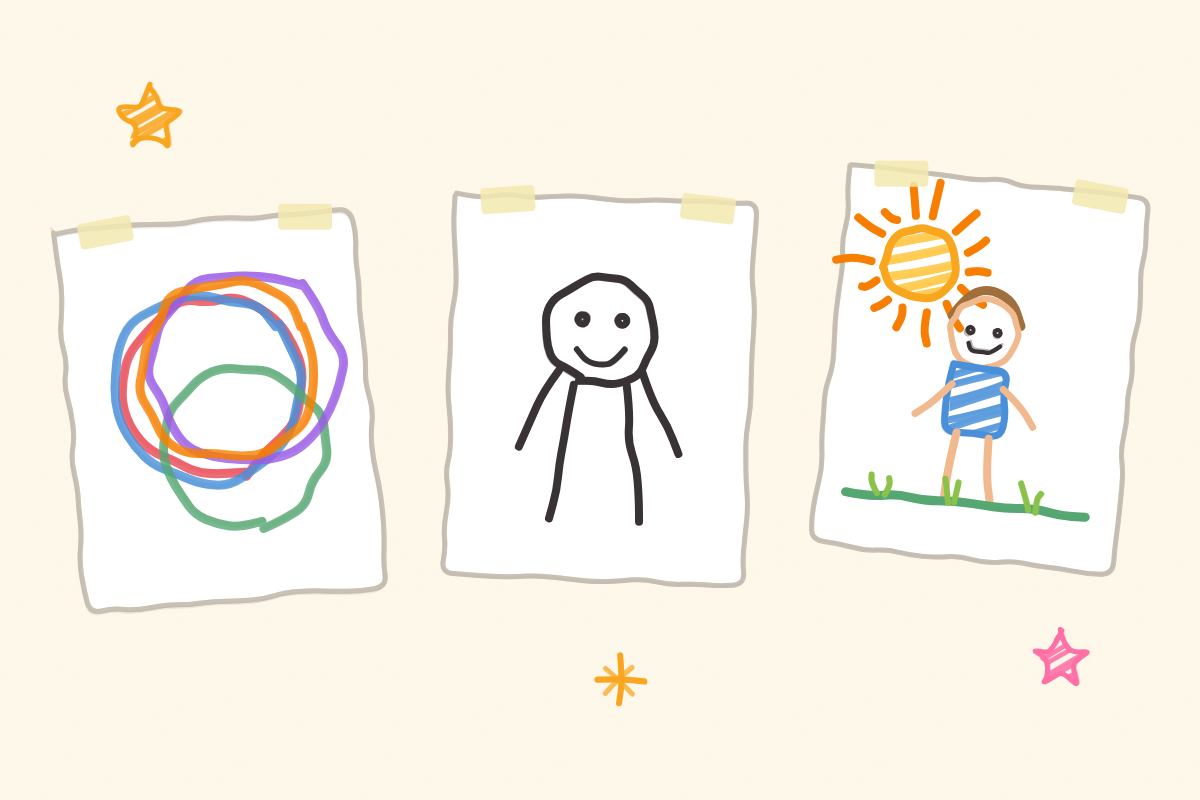
If you line up drawings from the same child at ages two, four, six, eight, and ten, you're looking at five different artists. The development between these points is not gradual — it comes in leaps, punctuated by plateaus, and each stage has its own distinct visual language that appears and then, quite suddenly, is gone.
Understanding this arc changes the way you see any individual drawing. You're not looking at a piece of art — you're looking at a document of a specific moment in a child's cognitive and emotional development. And that makes it a very different, and more interesting, thing.
Researchers have formal names for these phases — we've written a full guide to the stages of artistic development if you want the framework. This piece takes the other path: year by year, age by age, what you'll actually see on the paper in front of you.
The World as Marks: Age 2
At two, a child who picks up a crayon and makes a mark on paper is discovering something fundamental: that they can cause something to happen in the external world through deliberate movement. This is not nothing. It's actually enormous.
The drawings at this age aren't drawings in any representational sense — they're explorations of agency. What happens when I move my arm quickly? Slowly? What if I press harder? The child's face during these sessions often shows more absorption than any other activity — they're conducting experiments, and the results are endlessly interesting.
The marks themselves have no narrative content. But the act of making them is already the root of every artistic impulse that will follow.
Naming the Marks: Age 3
Around three, something changes. Children begin to name their scribbles — after completing them, typically, rather than before. They make a swirling shape and then look at it and say "that's a dog." This post-hoc naming is the beginning of symbolic thinking: the understanding that marks can represent things.
This is also the age when children often begin to have preferred colours — reaching consistently for the same crayon, using it until it's a stub. This isn't randomness. Colour preference in children has its own complex relationship to personality and emotion that becomes more interesting to track as the child develops.
The Human Figure: Age 4
The famous tadpole person — a circle with lines extending directly from it, no torso — typically appears around age four. This drawing, which looks simple, represents a developmental milestone: the child has created a stable, reproducible symbol that means "person."
The tadpole form persists, with variations, for one to two years in most children. Some children add bodies fairly quickly; others maintain the circle-with-lines for longer. Neither is better or worse. It's simply the schema the child has developed, and it will evolve when their visual thinking evolves, not before.
Faces, when they appear, tend to show the features that matter most to the child at that stage. Many four-year-olds draw prominent mouths — the most communicative feature — before they add consistent eyes or noses. This isn't inaccuracy; it's expressive priority.
A World in Fragments: Age 5–6
Around five or six, drawings begin to show a world rather than just figures. Houses appear. The sun occupies the top corner. A baseline emerges — a line across the page representing ground. Grass may appear along this baseline while the sky hovers separately at the top, leaving a blank space of air between them that doesn't correspond to visual reality but makes perfect conceptual sense.
This is the stage that produces the most universally recognisable "children's drawings" — the vocabulary that virtually every parent recognises. And within the apparent similarity, individual children are already developing distinct visual personalities. One child draws houses with enormous detailed windows. Another fills the baseline with flowers. Another is interested in weather, drawing clouds and rain with consistent care.
The Turn Toward Realism: Age 7–9
Around seven, children begin to want their drawings to look "right." The baseline becomes a more nuanced sense of ground. Figures acquire bodies, clothing, hair. The sky descends from the top of the page to meet the horizon. Perspective begins to appear — hesitantly, imperfectly, with buildings sometimes seen from multiple angles at once.
This is also the stage when self-criticism can appear for the first time. "I can't draw" is a sentence that emerges around this age, often in response to comparing their work to older children's or to visual reality. Understanding how to respond when children express doubt about their creative work matters particularly during this window.
The Narrative Artist: Age 9–10
By nine and ten, many children are drawing characters with backstories, environments with histories, scenes from narratives that exist in their heads. The drawing has become a tool for storytelling rather than just representation.
This is also the age when some children make a decisive turn toward illustration — copying characters from media they love, practising until they can reproduce them accurately — while others become more abstract, using drawings as private notation systems for the worlds in their imagination.
The artistic identity forming at this age is a real thing. The child who was drawing tadpole people at four has become an artist with preferences, a style, subjects they return to. All of it traceable, if you kept the work, back to those earliest crayon marks.
That's the arc. Eight years from agency to art, from a mark on paper to a world on paper. Every stage worth witnessing, every piece worth keeping — not because of the art, but because of who was making it. (And if the keeping is the hard part, here's what to actually do with all those drawings.)
A gentle note from us: we're parents and makers, not paediatricians. Every child is wonderfully their own, and they grow at their own pace. If something about your little one's development is weighing on your heart, please have a chat with your family doctor — that's exactly what they're there for, and asking is always the right call.
Ready to start keeping their stories?
My Mini Canvas is on iPhone and iPad now — free to start, no account needed.