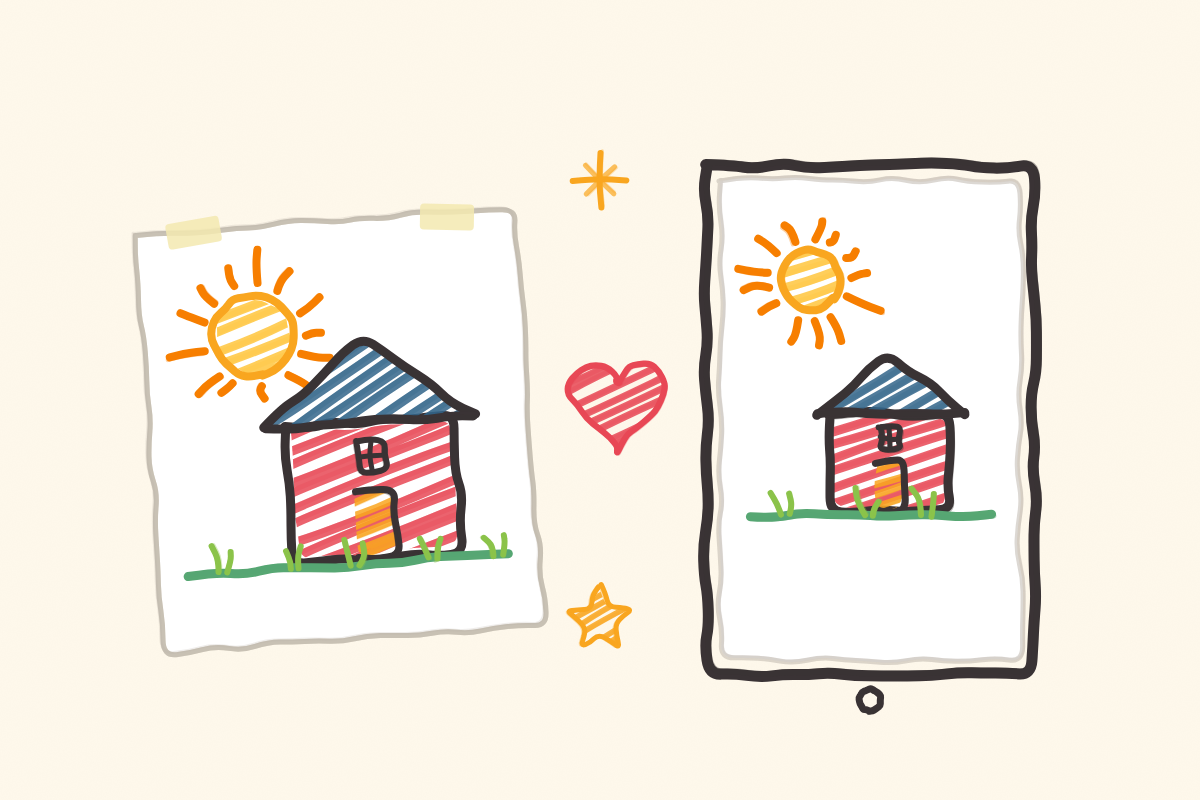
There's a box in many homes — under a bed, in a wardrobe, at the back of a cupboard — containing the physical evidence of a childhood. Crayon drawings with curling edges. School reports in plastic sleeves. A first pair of shoes that is somehow more heartbreaking than it should be. Mother's Day cards that were assembled with glue sticks and serious intent.
And there's a camera roll on most parents' phones containing thousands of images, scrolling back to the day the child was born, that they haven't fully looked through in years.
Both of these are legitimate archives. Both have real strengths. And both have failure modes worth understanding.
The Case for Physical
Physical keepsakes have a quality that no digital file can fully replicate: presence. You can hold them. They have texture, weight, the particular smell of old paper. When you pull out a drawing your child made at four, you're not looking at a representation of the object — you're looking at the object, the actual sheet of paper that their actual hand touched.
This is not trivial. Our relationship to physical objects and our relationship to digital images are processed differently. The physical artifact carries a kind of indexical authenticity — it was there — that a photograph, however accurate, doesn't quite match.
Physical keepsakes also don't depend on technology. They don't become inaccessible when a platform shuts down or a file format becomes unreadable. A drawing in a box is retrievable by anyone, at any time, with no login required.
The downsides are equally real. Physical keepsakes are vulnerable to fire, water, and the general entropy of physical existence. They take space. They require curation — you can't keep everything, so you have to choose. And they can't capture sound, movement, or the full context of a moment.
The Case for Digital
Digital keepsakes can hold things physical ones can't: voice, video, the timestamp of exactly when something was made. They can be backed up in multiple locations, making them far more disaster-resistant than a box under the bed. They can be searched, organised, and shared instantly with someone on the other side of the world.
The quality of a good digital archive is its completeness. You can capture not just the drawing but the explanation, the moment, the context. A digital record can contain more dimensions of a memory than any physical object.
The failure modes are worth knowing, however. Digital storage is dependent on the platforms that host it, and platforms change. Services close, pricing models shift, companies are acquired. The photos and videos you store in a cloud service today are only as retrievable as that service's continued existence. Many parents have experienced the particular grief of losing access to a digital archive — a crashed hard drive, a deleted account, a service that discontinued.
Privacy is also a real consideration. Many cloud platforms process uploaded content for advertising or training purposes. For something as personal as recordings of your child's voice and images of their artwork, the terms of service under which that content is stored matter. Privacy-first approaches to sharing and storing your child's data are increasingly something thoughtful parents are building into their habits.
The Honest Answer
The honest answer to "which is better" is neither — and both. The most robust approach combines the two in ways that play to each format's strengths.
Physical: the single most significant pieces. The drawing they worked on for days. The card they made for you with the spelling errors that make you want to cry. The artwork that is too textured or three-dimensional to photograph well. These get physical space.
Digital: the breadth of the archive. The everyday drawings, the voice recordings, the context and story. The things that would be lost to physical storage limitations but deserve to be kept. The medium that captures what the physical can't: sound, narrative, the explanation that gives the drawing its meaning.
What makes a digital archive genuinely valuable isn't the volume of what it contains. It's whether the things it contains will still be accessible and meaningful in twenty years. That means choosing platforms with longevity and privacy in mind, using formats that don't go obsolete, and building redundancy into the storage approach.
The goal isn't digital versus physical. It's a family memory archive that's complete enough, faithful enough, and robust enough that it lasts the whole lifetime you're building it for.
Thinking about how to build that kind of archive is one of the most future-facing things a parent can do right now.
Ready to start keeping their stories?
My Mini Canvas is on iPhone and iPad now — free to start, no account needed.