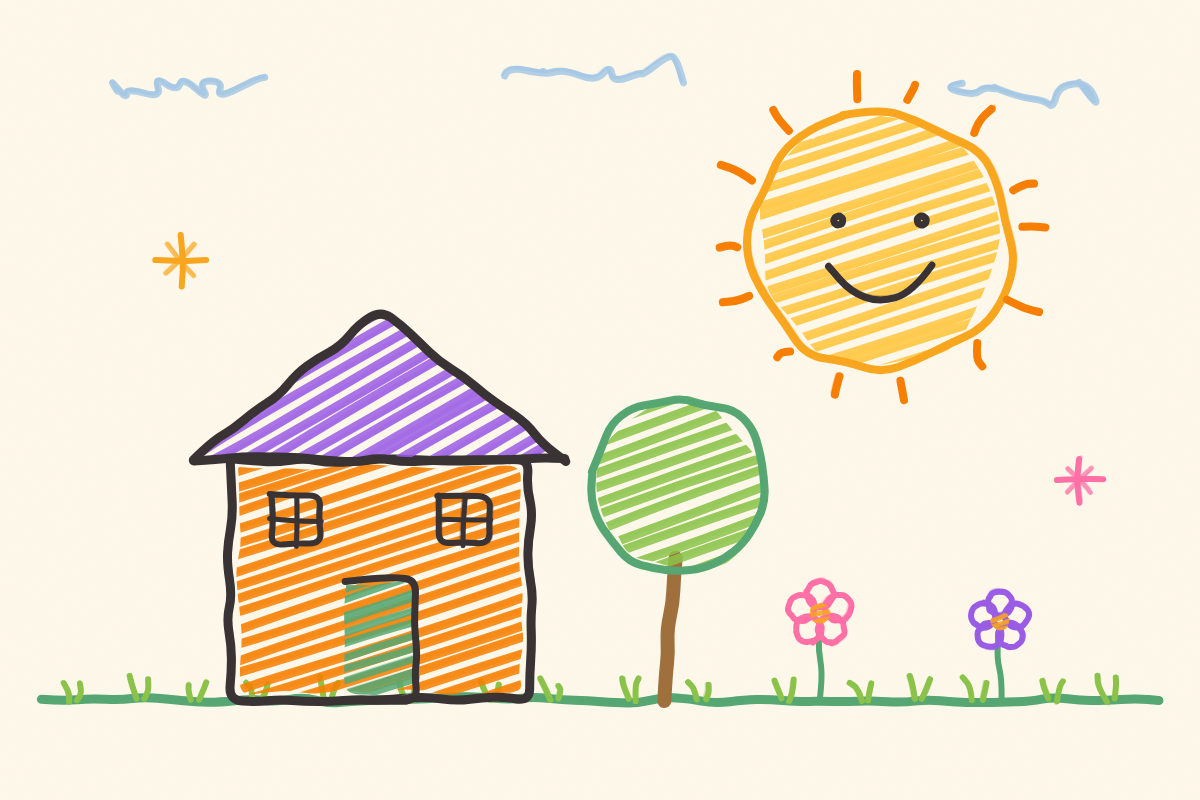
Let me describe a drawing to you. There's a person in it. The person has a round head, approximately the right number of eyes, and arms that emerge directly from where the ears would be, extending at confident angles to the sides. The legs are approximately twice as long as the body. The hands, where present, have six fingers on each. The sun in the top corner has seventeen rays. There's something in the background that may be a dog or may be a mountain — the artist was somewhat ambiguous on this point when asked.
It is, by any technical standard, incorrect. The proportions are off. The anatomy is creative. The perspective is a concept that hasn't been introduced to this drawing and has no plans to attend.
And yet.
What Makes Children's Art Honest
There is a particular emotional quality that children's drawings have — an aliveness, a directness — that most adult art works very hard to achieve and often cannot. The reason is simple: children's drawings are not performing. They're not trying to look right. They're not worried about whether you'll think they're good. They are simply an unmediated record of how a person saw something, at a specific moment, through the specific lens of their current understanding of the world.
The person with arms coming from their head is drawn that way because that's where the arms feel like they should be. The seventeen-rayed sun is drawn that way because seventeen rays felt like the right number for this sun, on this day, in this picture. The decision was made without calculation or self-consciousness. It was made from genuine creative instinct.
Adult artists — the really good ones — spend years trying to get back to this quality. To draw from genuine perception rather than from received convention. To see a thing rather than to draw what a thing is supposed to look like.
Children just... do it. Because they haven't yet learned to do anything else.
The Specific Beauty of the Wobbly Line
If you look at children's drawings with any regularity, you start to notice that the wobbly line — the line that shakes slightly as it moves across the page, that doesn't quite close the shape it intended to, that makes the house look a little like it's sighing — carries something that a confident, controlled line doesn't.
It carries the physical presence of the person who made it. You can see the concentration in a slightly uneven stroke. You can see the effort and the intention and the slight uncertainty about whether it's going right. A perfectly executed line is impersonal. A wobbly line is completely specific to the person who drew it.
This is also true of colour choice, of composition, of the particular subjects a child returns to. The drawing is not an approximation of their vision — it is their vision, exactly as it currently exists. There's nothing between the idea and the paper.
On Keeping the Imperfect Ones
Parents sometimes select for their children's "best" drawings — the most controlled, the most recognisable, the technically most accomplished. This is understandable but, over time, a slight loss.
The drawings that are technically imperfect are often the most vivid documents of a specific developmental moment. The tadpole person that appeared for six months and then was never drawn again. The phase where every drawing was in brown because brown felt right. The period when all characters had enormous mouths because the character of the mouths was the whole thing.
These drawings, kept and revisited, feel most like time travel. They show you a person thinking — working something out, drawing from inside a developmental stage that has since completely passed.
Building an archive that captures this range — not just the polished pieces, but the exploratory ones, the imperfect ones, the ones that look like what was happening in a child's mind rather than what they could execute well — produces something richer than a curated gallery of achievements.
The Anti-Perfectionism Lesson
Here's the thing: children who grow up in households where their imperfect art is celebrated — genuinely celebrated, not just tolerantly accepted — tend to grow up with a more resilient relationship to creative work. They learn that making something imperfect is better than making nothing. That the effort counts, that the vision counts, that not being good at something yet is a feature of learning rather than a verdict on the learner.
This is perhaps the deepest value of enthusiastically receiving messy, imperfect, technically incorrect children's art. You're not just appreciating a drawing. You're building a relationship with imperfection that will serve them across a lifetime of creative work, of skill development, of doing hard things before they can do them well.
The wobbly line is the best line. The too-many-fingered hand is the most honest hand. The seventeen-rayed sun is the most honestly observed sun.
Keep those drawings. Keep all of them.
Every child is different. Trust your instincts — you know your child best.
Ready to start keeping their stories?
My Mini Canvas is on iPhone and iPad now — free to start, no account needed.